
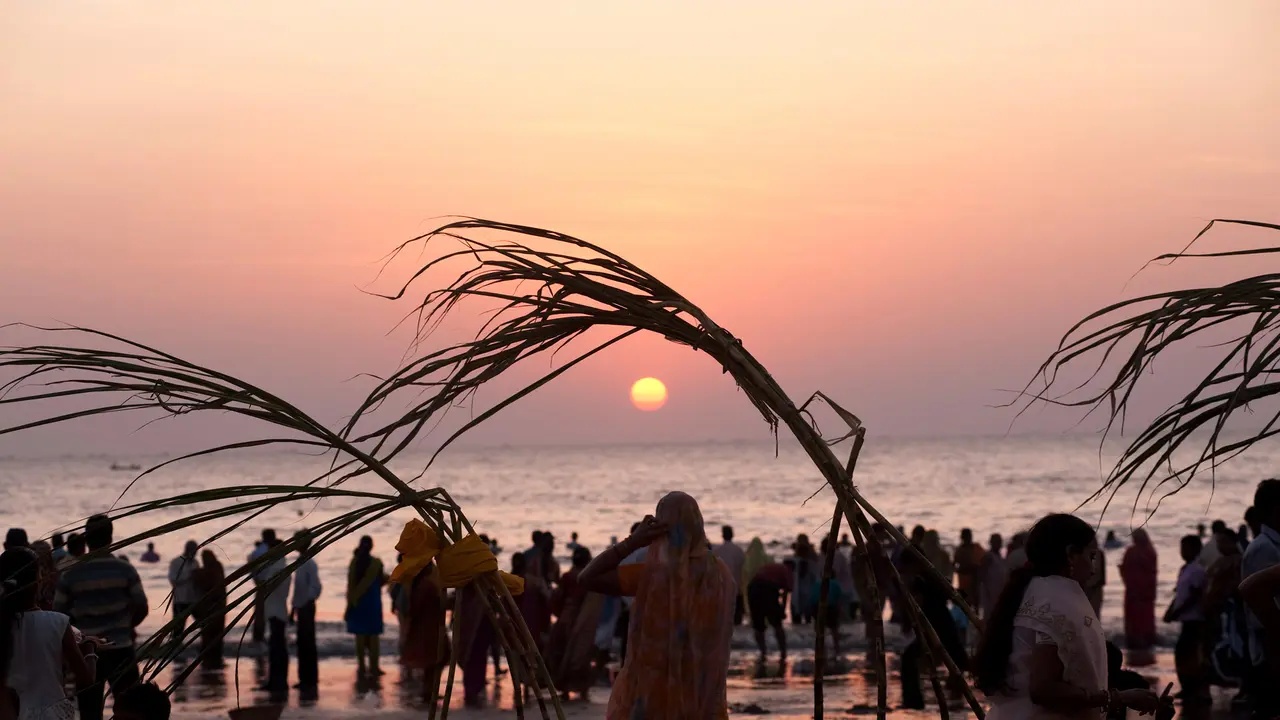
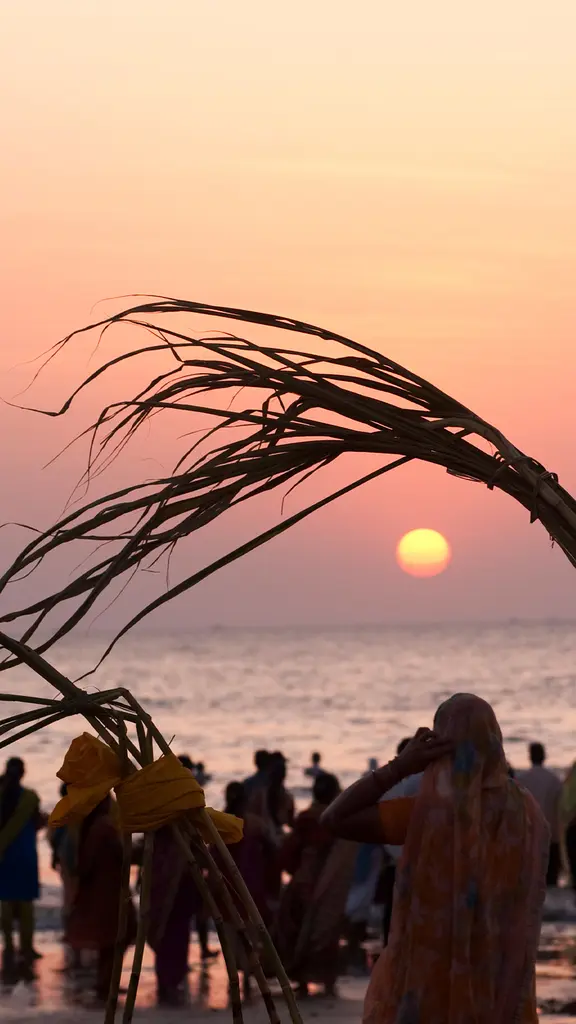
People worshipping the sun on Chhath, at Juhu Beach, Mumbai, Maharashtra (© Dinodia Photo/Getty Images)
Today's image features Mumbai's Juhu Beach, where waves meet devotion as thousands gather for Chhath Puja, one of India's most ancient and rigorous festivals. Though rooted in Bihar, Jharkhand and eastern Uttar Pradesh, the tradition travels with communities, turning city shorelines into spaces of worship beneath the open sky. Chhath is dedicated to Surya, the Sun God, and his consort Usha, revered as Chhathi Maiya. Devotees fast, pray and thank the Sun God for sustaining life while seeking blessings for health, prosperity and children's well-being.
The four-day festival is marked by fervour that deepens each day. Each of these days carries a distinct ritual—Nahai Khai, Kharna, Sandhya and Usha Argya—forming a cycle of cleansing. Fasting and prayers lead families to the water's edge, where offerings are placed in gratitude. At dusk, they bid the Sun farewell; at dawn, they welcome it once more—acts that mark both closure and renewal, keeping alive a tradition observed for centuries. Historians have traced this Sun worship back thousands of years, placing Chhath among the world's oldest living festivals. Chhath is even mentioned in the ancient Indian epics: the 'Ramayana' and the 'Mahabharata.' As the Sun dips below the horizon, the festival lingers on, like a hymn echoing through time.