
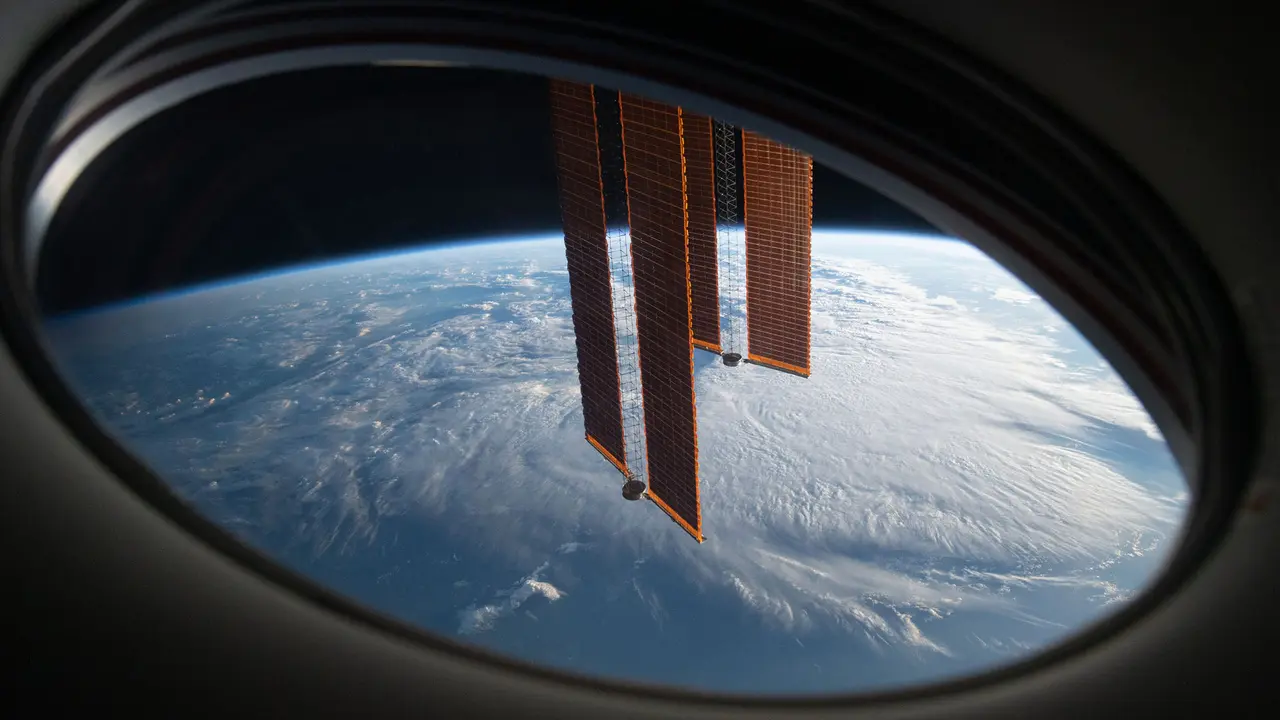
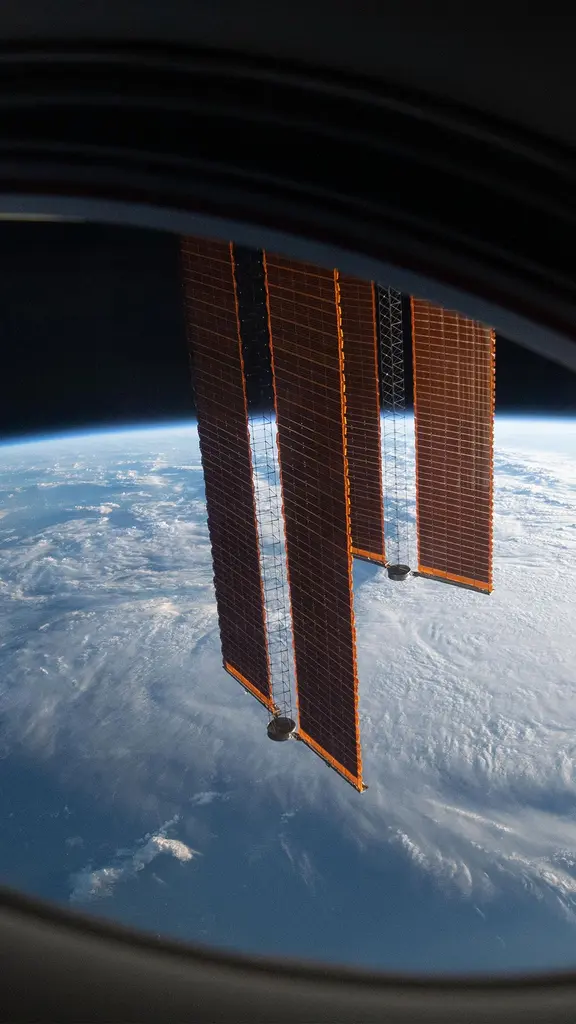
ISS main solar arrays seen from SpaceX Crew Dragon Endeavour (© NASA)
The first flower grown in space was a zinnia aboard the ISS in 2016, paving the way for future space agriculture.
From October 4 to 10, World Space Week invites us to transcend our earthly bounds and chase the stars. It was born from the launch of Sputnik 1 by the USSR in 1957 and the signing of the Outer Space Treaty in 1967, a pioneering international commitment to peaceful cosmic exploration. During this week, classrooms buzz with experiments, planetaria echo with wonder and telescopes bridge the gap to distant galaxies. Together, these moments weave a universal story of science, discovery and humanity's relentless drive to push boundaries. The week's mission is clear: to ignite the next generation of explorers, engineers and dreamers ready to rewrite the cosmos.
Today's image captures the International Space Station (ISS), a vast laboratory built by 15 nations, orbiting over 400 kilometres above Earth. Its solar arrays soak up sunlight to power groundbreaking research on microgravity, technology and human survival beyond our planet. Shot from the SpaceX Crew Dragon Endeavour—a reusable spacecraft that has completed six missions since 2020, ferrying astronauts and cargo—this scene embodies what humanity can achieve when it chooses co-operation over competition. Each gleaming panel makes it clear: the final frontier is within reach, and the audacity to explore it defines us.