
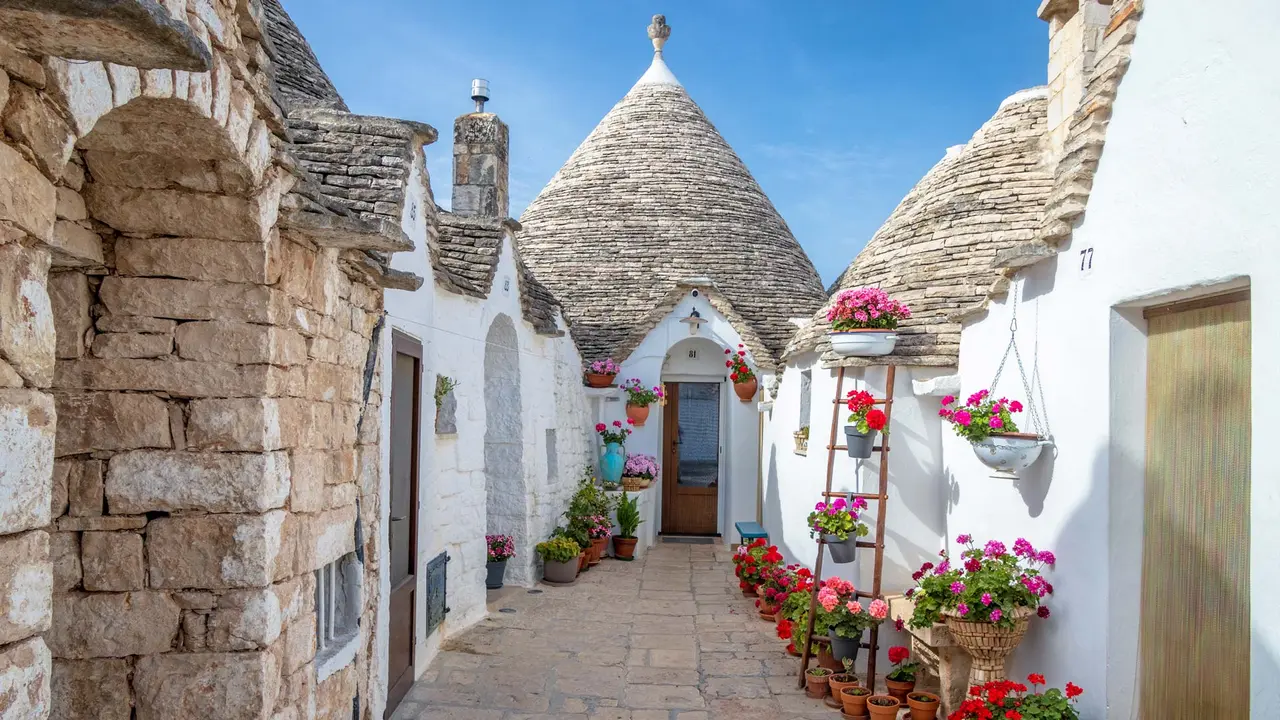
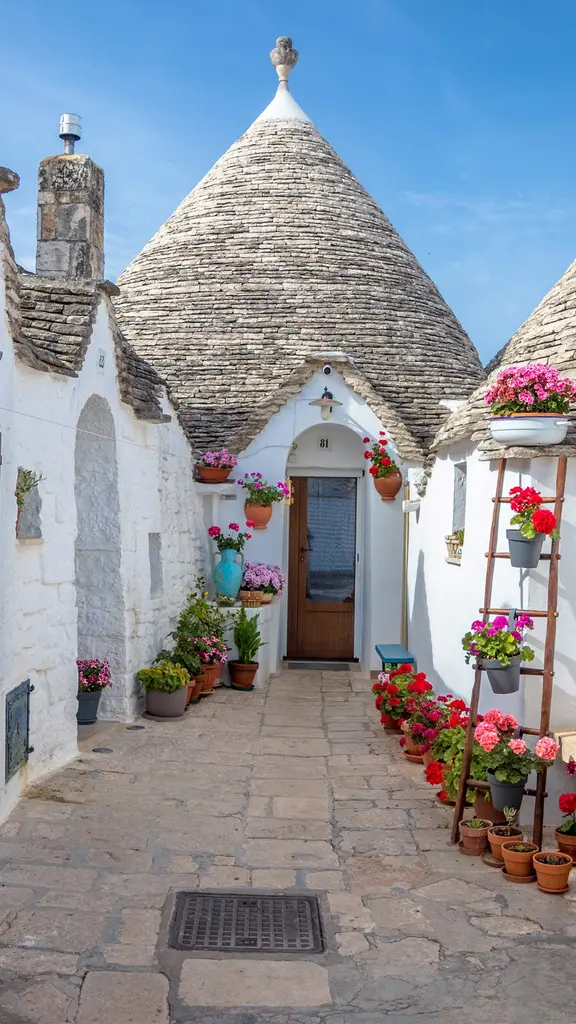
Trullo buildings in Alberobello, Apulia, Italy (© Feng Wei Photography/Getty Images)
If fairy tales had architects, they might've come up with something like Alberobello in Italy. But instead of magic wands, it was limestone, mortar-free masonry and—according to some theories—a bit of tax evasion that built this town's signature homes: the trulli. These are whitewashed stone houses topped with dry-stacked limestone roofs shaped like upside-down ice cream cones. It's an ancient building technique, and in this case, a clever one. Alberobello's trulli aren't hidden one-offs. Entire districts—like Rione Monti and Aia Piccola—are packed with these quirky structures. Some are still lived in, while others have been transformed into cafés, souvenir shops and pint-sized museums. You'll even find a church built in trullo style.
Meanwhile, in the quake-prone deserts of western India, another form of vernacular brilliance emerged: the bhunga. Developed after the 1819 earthquake in Kutch, these circular mud homes were designed to withstand seismic shocks. Built from locally sourced materials like mud, bamboo and timber, bhungas are as practical as they are beautiful—naturally regulating temperature and resisting both earthquakes and desert storms. Found mainly in Banni and Paccham, they stand as a testament to traditional knowledge and are often hailed as 'architecture without architects.'